 Jupiter
 combines trading and lending on Solana
Jupiter brings token swaps, perpetual trading, and collateral-backed lending together in a Solana-based decentralized finance platform. Swaps exchange tokens through aggregated liquidity, while perpetuals create leveraged price exposure and loans provide liquidity against deposited collateral. The platform also includes scheduled trading, staking, portfolio tracking, and wallet tools. These functions create different obligations: a spot trade changes your holdings, a perpetual position needs sufficient collateral, and borrowing creates interest-bearing debt. Solana-compatible assets and wallet support determine which actions work through a particular interface. Choosing a product starts with the intended outcome and the conditions for holding or closing that position.
Updated on
Spot Swaps and Failed Execution
Spot swaps use a compatible Solana wallet to exchange supported tokens, with the quoted route depending on available liquidity and execution settings. Routing can draw on several liquidity sources and split a trade where supported. When price movement exceeds the permitted slippage, the swap can fail without exchanging the tokens. A processed failure can still incur network fees. The on-chain transaction status distinguishes a completed exchange from a failed attempt before another submission.
Which Order Type Fits the Trade?
Market swaps exchange tokens immediately, Limit V2 orders wait for a price trigger, and DCA V2 orders distribute trades over time.
Ultra Mode automatically manages slippage and transaction submission, adjusting settings to market conditions. Manual Mode exposes those settings for direct control, including slippage and selected liquidity sources. Wider slippage permits a worse execution price; narrower tolerance can cause failure. Private submission in Ultra reduces exposure to front-running and sandwich attacks, although it cannot eliminate that risk. Manual Mode lacks that built-in protection and excludes Jupiter’s refund and support arrangements for its transactions.
Limit V2 triggers use a token’s dollar price or market capitalization. Execution draws on liquidity available when the trigger fires, so final output can differ from the earlier estimate. Partial fills may leave an unfilled remainder active. Take-profit and stop-loss orders automate exit conditions without guaranteeing the originally estimated proceeds. Legacy Limit V1 no longer accepts new orders.
DCA means dollar-cost averaging. Scheduled suborders buy at their execution prices, and an optional V2 price range can postpone purchases. Failed suborders retry at the next scheduled interval. Eligible time-based V2 orders can opt into lending yield on waiting stablecoin capital, adding lending exposure. DCA V1 no longer accepts new orders; the mobile interface still uses the label Recurring.
Lend Vaults and Collateral Limits
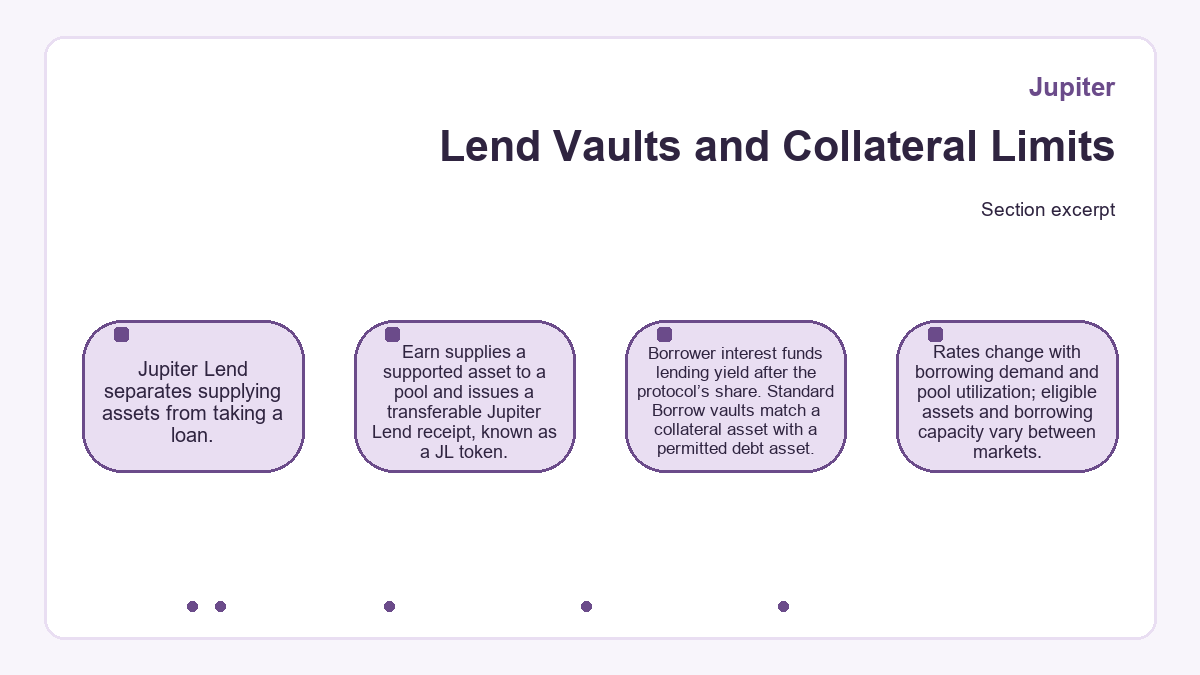
Jupiter Lend separates supplying assets from taking a loan. Earn supplies a supported asset to a pool and issues a transferable Jupiter Lend receipt, known as a JL token. Borrower interest funds lending yield after the protocol’s share. Standard Borrow vaults match a collateral asset with a permitted debt asset. Rates change with borrowing demand and pool utilization; eligible assets and borrowing capacity vary between markets.
A position’s net equity is its collateral value minus its debt value, measured in dollars. A position becomes eligible for partial liquidation when its debt-to-collateral ratio reaches its vault’s liquidation threshold. Borrowing and liquidation limits come from the selected vault’s current configuration. APY stands for annual percentage yield.
| Parameter | Calculation | Interpretation and Risk |
|---|---|---|
| Debt-to-Collateral Ratio | Debt value / collateral value, both in dollars | Reaching the vault’s liquidation threshold permits partial liquidation. Above the vault’s Liquidation Max Limit, the position is fully liquidated to zero. |
| Utilization Rate | Borrowed units / supplied units of the same token | Higher utilization can raise interest rates and constrain immediate withdrawals. |
| Net APY for Standard Positions | (Collateral value × supply APY - debt value × borrow APY) / (collateral value - debt value), using dollar values | The percentage applies to net equity, not all collateral. |
Multiply borrows against collateral, converts the borrowed asset into more collateral, and redeposits it within one atomic transaction. Exposure and debt rise together, amplifying potential gains and losses. Unwind uses collateral to repay debt and reduce leverage in supported vaults. Strategies apply maximum leverage to selected pegged vaults and support only full withdrawals, which unwind the entire position. Pegged pricing reduces sensitivity to market-price movements, while interest-rate divergence can still push a position toward liquidation.
The Bitwise x Ethena Market is winding down, with migration to a separate Sentora Market or gradual closure. Its final exit deadline is not yet set. Close positions in this market before the deadline to avoid negative interest. Repay debt and withdraw collateral gradually during the wind-down. Avoid the Multiply page’s Unwind action because its collateral swap can suffer slippage in thin liquidity.
Smart Vaults add an opt-in liquidity function to a position’s collateral or debt. Eligible token pairs supply liquidity to Jupiter AMM, an automated market maker, and trading fees add yield or offset borrowing costs. The pair’s composition can change as swaps pass through it. Smart Earn is a separate supply-only product without borrowing debt or liquidation exposure. Standard Earn, Borrow, and Multiply positions have no exposure to Jupiter AMM.
How Do Perpetuals Differ From Spot Swaps?
Perpetuals create leveraged long or short positions, while spot swaps exchange tokens that become part of a wallet’s holdings. The JLP pool acts as the counterparty to Jupiter’s pool-backed perpetual markets. Those markets use oracle prices and charge borrowing fees while positions remain open. Execution in those markets uses a keeper after the trader submits an on-chain request. The request alone does not establish that a position has opened or closed.
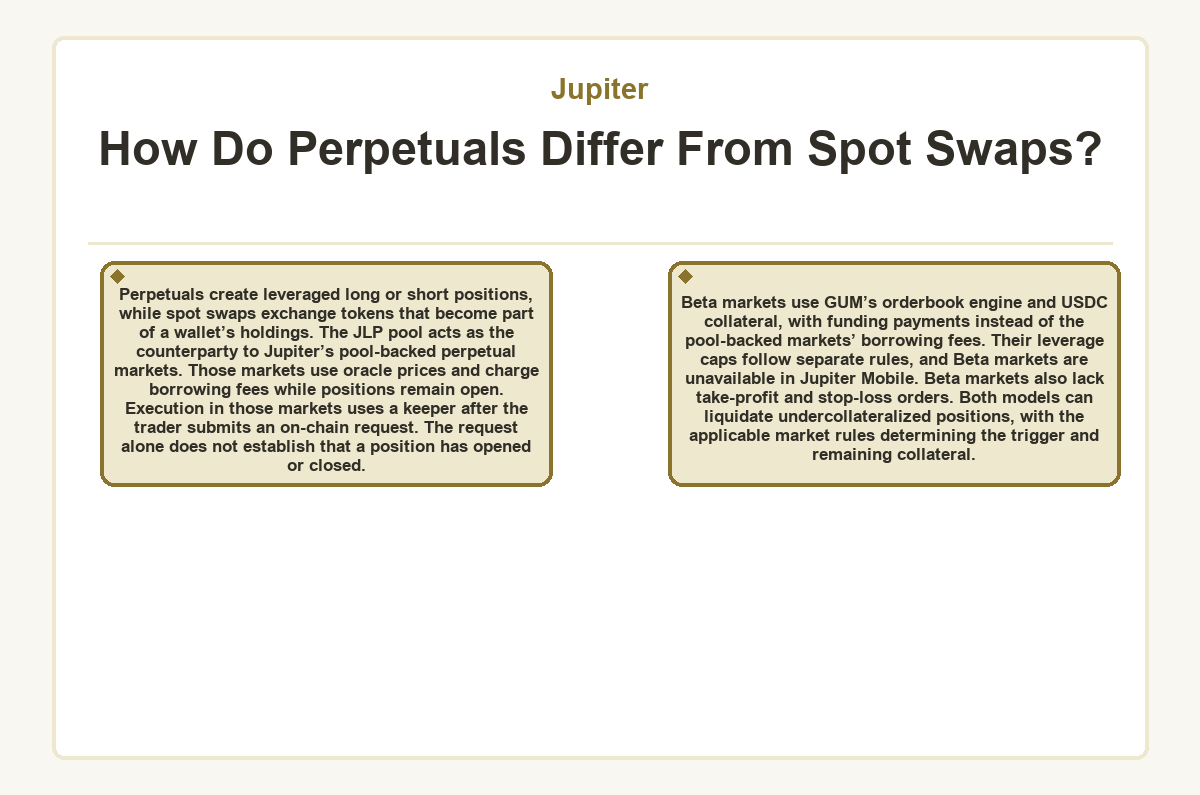
Beta markets use GUM’s orderbook engine and USDC collateral, with funding payments instead of the pool-backed markets’ borrowing fees. Their leverage caps follow separate rules, and Beta markets are unavailable in Jupiter Mobile. Beta markets also lack take-profit and stop-loss orders. Both models can liquidate undercollateralized positions, with the applicable market rules determining the trigger and remaining collateral.
JUP, JLP, Staked SOL, and JupUSD
JUP is the governance token. Staking it enables proposal voting through the Jupiter DAO, a decentralized autonomous organization. Holding JUP creates a different exposure from supplying lending liquidity or owning JLP; it does not grant a direct entitlement to protocol fees.
JLP represents a share of the liquidity pool. Its value reflects the pool’s assets, trading-fee income, and trader profits or losses. Profitable traders receive funds from the pool, reducing its value, while asset-price declines can also hurt holders. JLP can be acquired through a swap or minted through supported pool deposits.
SOL staking earns validator rewards. Native staking uses a stake account whose activation and deactivation follow Solana epochs. JupSOL represents liquid-staked SOL and remains transferable and tradable. Selling it uses market liquidity; delayed unstaking follows its redemption process. A lending protocol must support the particular staking asset before accepting it as collateral.
JupUSD is a reserve-backed stablecoin. Holding it alone earns no yield; the JUICED lending receipt combines borrower interest with yield from the reserves.
Wallets, Funding, and Additional Markets
Jupiter Wallet provides a self-custodial Solana browser extension, while Jupiter Mobile supplies wallet access on supported mobile devices. External Solana-compatible wallets offer another connection path. Deposit includes supported cross-chain funding, bridge-and-swap routes, card purchases, and transfers from centralized exchanges. Each method has its own provider requirements and delivered assets. Matching tickers on different blockchains do not establish that an asset is compatible with a Solana product.
Jupiter Predict trades contracts on event outcomes, with settlement conditions that vary by market. Losing contracts can expire worthless. Tokenized stocks trade through Spot, while third-party issuers determine backing and redemption rights. Direct redemption can require issuer onboarding and jurisdictional eligibility. Offerbook, available in Beta, provides peer-to-peer USDC loans with fixed terms. It avoids price-based liquidation during the loan; nonrepayment after maturity allows the lender to claim collateral.
Portfolio consolidates supported Solana holdings and DeFi positions. Watching an address reveals public activity without granting authority to move its funds. Developers can integrate swaps, token data, prices, and lending through application programming interfaces (APIs) and software development kits. An integration’s supported methods and fees can differ from those of the consumer web interface.
Costs and Exit Choices
Spot costs depend on execution mode, token characteristics, and network conditions. Manual market swaps have no Jupiter commission, although network fees and optional validator tips remain. Qualifying Ultra swaps can use gasless execution. Relayer support requires an eligible input token and sufficient trade value for gas recovery; recovered network costs come out of the trade. JupiterZ market makers cover network and priority fees, but exclude token-account rent. That route is unavailable when a missing token account needs rent that the wallet cannot pay. Native mobile swaps follow their own fee schedule.
A lending deposit’s displayed value and amount available for immediate withdrawal are different quantities. Borrowed pool funds and dynamic withdrawal limits can restrict immediate access. Trading directly in one liquidity pool exposes a swap to that pool’s depth; aggregation compares eligible liquidity sources. Selling an asset provides liquidity without opening a borrowing position. Borrowing retains exposure to the deposited collateral, and any outstanding debt continues to accrue interest.
Jupiter - common questions
Is JUP Required to Make a Token Swap?
JUP is not required simply to use Jupiter’s spot swap service. It is the governance token, while ordinary Solana network fees use native SOL. Some qualifying swaps cover network fees through gasless mechanisms, with route-specific conditions and costs.
Does a Token Appearing in Jupiter Spot Mean It Has Been Verified?
A token can appear in Spot before it has passed verification. Permissionless token creation allows different assets to share a name or ticker. The mint address identifies the actual token, while verification indicators describe a separate review status. Mint or freeze authority can affect supply or transfers, so discoverability alone does not establish that those controls are absent.
Can Wrapped SOL Pay Solana Transaction Fees?
Wrapped SOL cannot directly pay Solana network fees. The network uses native SOL, while wSOL is the token form that protocols transfer through token accounts. Standard swaps generally handle wrapping and unwrapping automatically. Manual Mode can retain wrapped output when its corresponding setting is enabled, so a SOL-related token balance may still leave a wallet short of native fee funds.
What Happens When a Jupiter Lend Position NFT Moves to Another Wallet?
Transferring a Borrow or Multiply Position NFT transfers ownership of the entire position, including its collateral and debt. The non-fungible token (NFT) represents control of that position, so burning it destroys the object required to manage or withdraw its funds. An Earn JL token represents a pool deposit; transferring it moves the claim on that deposit rather than a borrowing position.
Why Is a Cancelled Limit V2 Order Still Marked Pending Withdraw?
Pending Withdraw means the order has stopped, but its locked tokens remain in the order vault. Cancelling with the vault session can stop an order without transferring funds. Returning those tokens requires a separately signed withdrawal transaction. Rejecting or closing that signature request can leave the withdrawal pending even though the order itself no longer runs.
How Can I Access Jupiter Without a Browser Wallet Extension?
Jupiter Mobile provides a wallet connection path, and Quick Accounts support email or social sign-in through an embedded wallet. Quick Accounts use a private key rather than a recovery phrase, and that key can be exported through the website. An exported key grants full control over that wallet and must remain private.