 Jupiter
Jupiter routing through pools and market makers
Jupiter routing compares eligible liquidity sources to find token swap paths on Solana for the selected trade amount. Pool routes can pass through intermediate tokens or split across venues. Market-maker quotes provide another source of liquidity, while the integration path and transaction settings determine which routing engines can compete.
Updated on
Route availability depends on the trade amount and eligible liquidity sources, so changing transaction settings can change the winning quote.
Managed Execution or Custom Transactions
Transaction modification determines which Swap V2 integration path fits: managed orders provide assembled transactions, while the Router provides instructions for custom construction.
Assembled Swap Orders
The Meta-Aggregator lets Metis, JupiterZ, DFlow, and OKX compete when the request permits their participation. Its
order
operation returns a quote and assembled transaction together;
execute
handles the wallet-authorized transaction’s submission and confirmation. The returned message must stay unchanged, so custom instructions require a different integration path.
Custom Swap Instructions
The Router’s
build
operation returns a quote and raw instructions through Metis. It supports custom construction and cross-program invocation (CPI), where another Solana program calls the swap program. The integration handles simulation and submission through a remote procedure call (RPC) connection or Jupiter’s submission infrastructure. Router transactions cannot use
execute.
Token Inputs and Executable Quotes
A routing request specifies the input mint, output mint, and amount in the input token’s smallest units. Mint addresses identify exact assets, while token decimals determine how displayed amounts convert into those units. Comparable quotes need matching amounts and settings. The
router
field identifies the winning engine;
routePlan
entries describe venues, token movements, and swap allocations where provided. Building an order transaction also requires the taker’s wallet address. Balance and account requirements can prevent transaction construction even when pricing exists.
A Swap V2 order without a taker returns pricing without a transaction. An empty transaction accompanied by an error indicates that a quoted swap cannot proceed.
Direct Paths, Intermediate Tokens, and Split Routes
Metis supports direct, intermediate-token, and split routes within market and transaction constraints. A direct path connects the chosen mints without an intermediate token, although a longer path can offer more output.
Intermediate Tokens
A multi-hop path exchanges the input through another token before reaching the requested output. Each leg supplies the next, making every market’s liquidity relevant to the complete path. Venue fees and price impact affect its quoted output. Several legs can execute together within one Solana transaction.
Splits Across Liquidity Sources
A split route assigns portions of the input to different paths, potentially reducing pressure on a single pool. An intermediate-token path need not split its input. Allocations describe how the same swap distributes its input, and the selected combination must fit into an executable transaction.
Pool Quotes and Market-Maker Liquidity
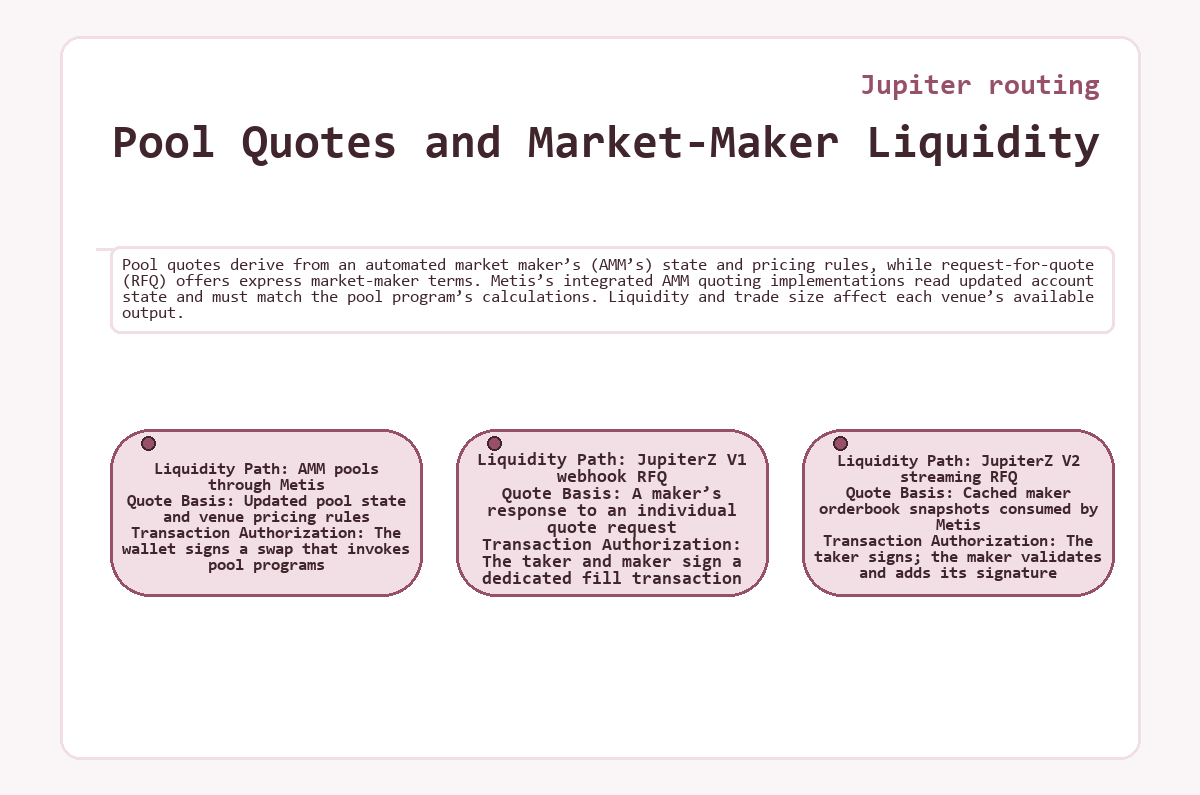
Pool quotes derive from an automated market maker’s (AMM’s) state and pricing rules, while request-for-quote (RFQ) offers express market-maker terms. Metis’s integrated AMM quoting implementations read updated account state and must match the pool program’s calculations. Liquidity and trade size affect each venue’s available output.
| Liquidity Path | Quote Basis | Transaction Authorization |
|---|---|---|
| AMM pools through Metis | Updated pool state and venue pricing rules | The wallet signs a swap that invokes pool programs |
| JupiterZ V1 webhook RFQ | A maker’s response to an individual quote request | The taker and maker sign a dedicated fill transaction |
| JupiterZ V2 streaming RFQ | Cached maker orderbook snapshots consumed by Metis | The taker signs; the maker validates and adds its signature |
Dedicated JupiterZ Quotes
JupiterZ’s V1 webhook model requests quotes from market makers for a particular swap. The selected maker validates the taker-signed transaction before co-signing and landing the fill through the Order Engine program. A maker can reject execution during this last-look stage.
Streaming Quotes Inside Metis
JupiterZ’s V2 streaming model publishes orderbook snapshots that Jupiter caches for routing. Metis consumes market-maker liquidity from JupiterZ V2’s streaming orderbooks. These fills use the swap aggregator and RFQ fill program, with maker validation and co-signing. V1 and V2 operate concurrently, using different settlement programs.
DFlow is a third-party on-chain router, and OKX supplies an additional liquidity source. Both compete through the Meta-Aggregator when eligible.
Why Can a Routable Token Have No Quote for This Amount?
Route availability depends on the requested amount, eligible venues, and their usable liquidity. Metis applies market-listing conditions that can remove a pool from routing, while other engines may still quote the pair through the Meta-Aggregator. Market makers also choose which pairs and sizes they quote, with inventory constraints and market conditions affecting their offers. A request can therefore fail to find liquidity without establishing a permanent token restriction or proving that every Jupiter engine lacks a path.
Routing settings can also remove candidates. On Swap V2 orders, a separate integrator fee payer restricts routing to Metis. Decentralized exchange (DEX) exclusions affect Metis alone, while router exclusions remove entire engines. A venue restriction can eliminate an intermediate leg as well as a direct market.
Account Limits and Routing Speed
Transaction account limits constrain Metis’s liquidity combinations, particularly when custom instructions need additional accounts. Reducing
maxAccounts
can make a custom transaction fit, but setting it too low can exclude useful pools or splits, worsen pricing, or leave no route. Swap V2’s
build
operation also offers a beta fast mode that trades quote optimization for lower routing latency. Its Bellman-Ford search avoids splitting and overlaps routing with the priority-fee lookup. That lookup uses global fees because the route’s writable accounts are not yet known, which can make the estimate less accurate. An unsplit path can still contain intermediate tokens. Fast mode may return less output than default routing when splitting would improve pricing, and lower computation latency does not establish successful network execution.
Price Impact, Slippage, and Quote Expiry
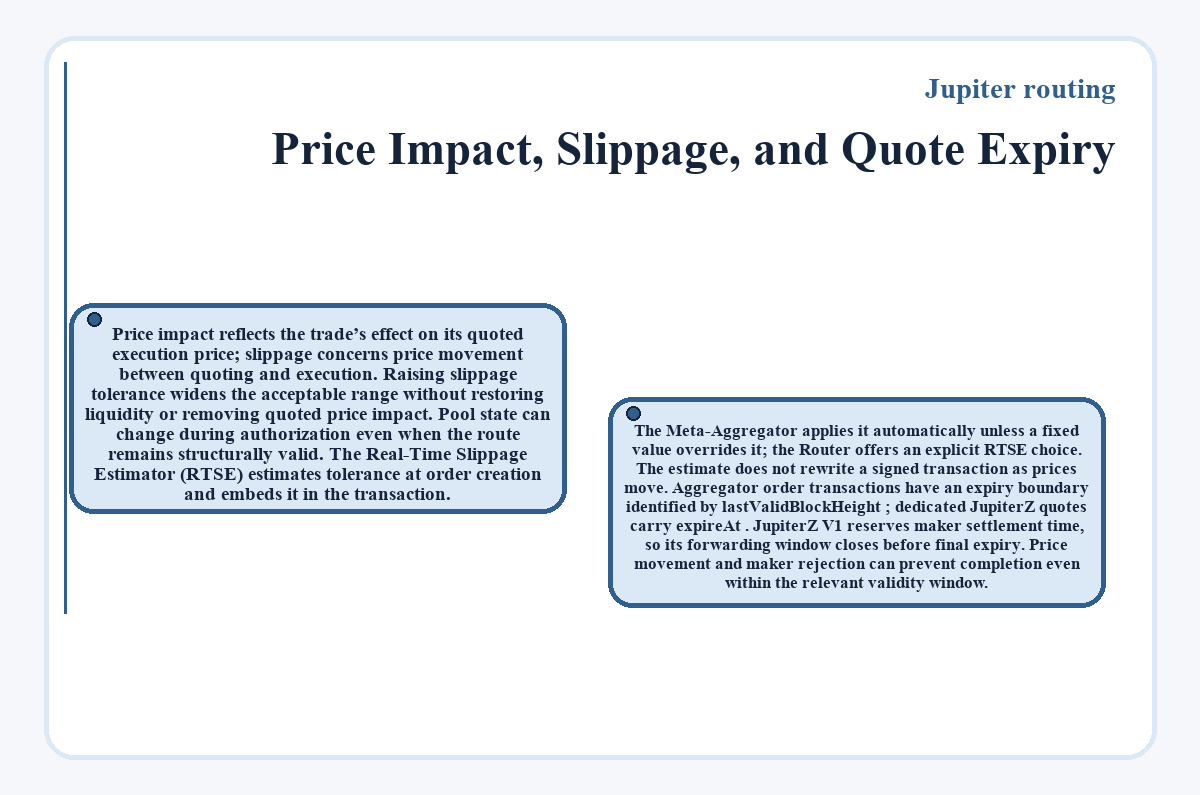
Price impact reflects the trade’s effect on its quoted execution price; slippage concerns price movement between quoting and execution. Raising slippage tolerance widens the acceptable range without restoring liquidity or removing quoted price impact. Pool state can change during authorization even when the route remains structurally valid.
The Real-Time Slippage Estimator (RTSE) estimates tolerance at order creation and embeds it in the transaction. The Meta-Aggregator applies it automatically unless a fixed value overrides it; the Router offers an explicit RTSE choice. The estimate does not rewrite a signed transaction as prices move.
Aggregator order transactions have an expiry boundary identified by
lastValidBlockHeight; dedicated JupiterZ quotes carry
expireAt. JupiterZ V1 reserves maker settlement time, so its forwarding window closes before final expiry. Price movement and maker rejection can prevent completion even within the relevant validity window.
Route Output and the Received Balance
A completed swap requires successful execution and corresponding token changes; a transaction signature alone can also identify a failed attempt. Solana executes transaction instructions atomically, so a failed swap leg reverts the swap changes. A processed failure can still incur network fees, and submission alone does not establish completion.
Fees distinguish route output from the credited token amount. Meta-Aggregator orders include applicable Jupiter platform fees, while the Router does not charge Jupiter swap fees. Pool fees, network charges, and integrator fees remain separate costs. A Router integration can configure its own platform fee, so that path can still incur swap charges.
Swap V2 execution results distinguish route amounts from wallet amounts. For an order that credits the taker and collects fees in the output mint,
outputAmountResult
records output before that fee. The quote’s
outAmount
remains an estimate, while the completed exchange’s final credited amount appears in
totalOutputAmount.
Jupiter routing: what people ask
Can I Request an Exact Output Amount Through Swap V2 Orders?
Swap V2’s order operation supports ExactIn, which fixes the input amount and quotes the resulting output. It does not offer an ExactOut selection.
Does Manual Mode Mean That Jupiter Used Metis?
Manual mode identifies an order with optional parameter changes, while the router field identifies the winning engine. Some settings restrict eligibility, and others leave all engines available. The mode field alone cannot distinguish Metis from JupiterZ or another routing engine.
Will Adding a Referral Fee Remove JupiterZ From Routing?
Referral fees alone do not disable JupiterZ on Swap V2 orders. Setting a separate integrator payer changes engine eligibility, which is a different setting. With referral fees on a JupiterZ order, the taker must fund any required output token account rent, even when the maker pays network fees.
Which Address Does the Swap V2 Receiver Parameter Accept?
The receiver parameter accepts a wallet address that differs from the taker. For output other than native SOL, the swap sends tokens to the receiver’s associated token account and can include its creation. The Router’s destinationTokenAccount parameter instead accepts an SPL token account.
How Can a DEX Label Cause a No-Routes Error?
DEX labels are case sensitive, and an unrecognized label in the Router’s dexes parameter can produce the same no-routes response as insufficient liquidity. The Router supports either dexes or excludeDexes, but rejects a request that supplies both. On Meta-Aggregator orders, dexes does not restrict venue selection.
Are Metis Swap API V1 Parameters Interchangeable With Swap V2?
Metis Swap API V1 and Swap V2 have different request and response contracts. The Router combines quoting and instruction retrieval, uses taker for the swapping wallet, and treats bps as the canonical route allocation field. Older percentage parsing can therefore misrepresent the route.
What Makes a Gasless Quote Different From a Free Swap?
A gasless quote assigns network-fee payment to another payer. Pool costs, swap fees, and any applicable sponsorship recovery charge can still affect the exchange amount. The quote’s fee breakdown and payer fields determine which charges the taker bears and which another party funds.